Showing posts sorted by relevance for query explanatory reductio. Sort by date Show all posts

Monday, June 9, 2014

The explanatory reductio

“It ain’t what you don’t know that gets you into trouble. It’s what you know for sure that just ain’t so.”

                                                                                                                                     ~ Mark Twain

One simple way of identifying the defining characteristic of an explanation is to distinguish it from an argument. Whereas an argument provides reasons we should believe something, an explanation provides reasons why something we already believe, actually occurs.  In rhyme:
  • An argument says how we know. 
  • An explanation says why it is so.
This is an excellent general purpose way to think about the nature of explanation (and argument) and I recommend tattooing it somewhere special. 

But it isn't the whole story. To appreciate why, let's begin with Twain's lovely remark: Sometimes what we know just ain't so.  Of course, if you are accustomed to philosophical usage, you'll see that this is paradoxical: knowledge implies truth. So, in more quotidian terms, Twain is observing that we are often utterly convinced of things that turn out to be false.

I doubt any reader of this blog will need to be convinced of Twain's fundamental point, that passionate commitment to falsehoods can cause far greater harm than simple ignorance.  My point is that what we know that ain't so is also a nice way to  appreciate the fact that explanation has a larger role than simply accounting for the facts.

Consider an everyday example.  I get a check in the mail saying that I have just won 10 million dollars. Do I even bother to open it?  Nope.  I can partly defend this by appeal to probability and expected value: It is so fantastically unlikely that 10 million dollars would simply drop out of the sky that the time it would take to inquire is far more trouble than its worth. But the other, equally important way of accounting for it is explanatory in nature: Why the hell would anyone just give me 10 million dollars? If there is no plausible explanation, maybe that's because they didn't.

Now, what exactly am I doing when I put the matter this way?  Am I accepting it as actual fact that I won 10 million dollars and proceeding to explain said fact?  No, rather, I am engaging in what I will call an explanatory reductio ad absurdum.  

You are familiar with the standard reductio:  We accept a claim for the sake of argument, and show that it implies an absurdity.  In the explanatory reductio we accept something for the sake of explanation, and show that it rests on an absurd understanding of the world.

Here is one of my favorite New Yorker cartoons, which makes the point beautifully.


So our powers of explanation do not, as our initial definition suggests, exist simply to help us understand independently established facts. Rather, we often engage in explanation in order to determine whether we've got hold of the right ones. 

Some other examples:

Did you see the movie A Beautiful Mind?  There is a poignant moment in which John Nash, a (real life) brilliant mathematician and game-theoretician suffering from schizophrenia uses the power of pure reason to break the grip of his mental illness and convince himself that a young girl appearing to him over a long period of time is not real. 


Nash uses an explanatory reductio:  If she is real, why doesn't she get older?

Another.  I recently read Philip Roth's book American Pastoral.  It is predicated on a sensationally unlikely event: A teenage girl raised in an affluent New York family by two devoted and loving parents (allegedly) bombs a local post office, killing a local man, an (apparently) loco act of protest against the Vietnam War, and then (unquestionably) disappears. Almost the entire book is an act of excruciating soul searching in which the girl's father attempts to understand how a child he raised could have performed such an abominable act. There is just no explanation for it compatible with his understanding of the world. Consequently- he often confidently concludes, only to reverse himself a moment later- she simply could not have done it.

Or consider an example from science.  You are probably familiar with the Alvarez hypothesis (named after Walter Alvarez and his famous dad Luis) which claims that the massive extinction at the end of the Cretaceous period  (think dinosaurs) was caused by a massive asteroid. Although widely accepted today, it was initially met with scorn by the scientific community, especially by biologists who were deeply committed to the view that evolution necessarily occurs gradually. The gradualists employed an explanatory reductio: The very fact, Professors Alvarez, that you must appeal to Biblical scenarios like this one to explain this sudden massive extinction of the dinosaurs is a very good reason for thinking that no such extinction event ever occurred (i.e., that it is just an illusion created by an incomplete fossil record.)

The famous theoretical physicist Richard Feynman characterized the explanatory reductio about as elegantly as one can in this brief clip:


Ok, enough, now you are coming up with examples of your own. They're everywhere. So what is the subtler account of explanation that emerges here?

Try this: Explanation is fundamentally an attempt to improve our understanding of the world. Sometimes accepted facts will challenge our limited understanding and we are forced to develop better theories to account for them. Other times a better understanding of the world will challenge our 'facts', and we are forced to consider the possibility that what we know just ain't so. On those occasions, our understanding will be improved by explaining how we came to be convinced of a falsehood.  As I'll explain in a future post, a very large number of pivotal explanatory episodes in the history of science can be understood in this way, not as the explanation of accepted facts, but as the explanation of universal illusions.

G. Randolph Mayes
Department of Philosophy
Sacramento State

Sunday, September 21, 2014

Explanation and illusion


This is a sequel to a post I wrote in  June called "The explanatory reductio." The point there was this: Although an explanation is an attempt to understand an accepted fact, sometimes our inability to provide an explanation becomes a reason for rejecting the 'fact' instead. If you can't explain that beautiful creature in your bed, maybe it's not your bed.  Here I offer the following observation, and provide you with some examples:

Many of the greatest intellectual insights in human history resulted from someone explaining a widely accepted fact, as a grand illusion.

1. The moon illusion

As everyone knows, the moon is larger when it appears on the horizon than when it is high in the night sky. Sometime back in human prehistory ancient people wondered: Why does the moon grow and shrink like that? One evening, while sitting at his fire after a fruitless day of hunting, the famous cave philosopher Og, had an epiphany.

Og say moon not get small. Moon only look  small. Moon like prey, get small when run away.

Og was the first to articulate the appearance/reality distinction, an incredible leap in human understanding. Later astronomers accepted Og's view that the changing size of the moon is illusory, but they rejected his explanation. They believed all celestial bodies move in perfect circles, with the earth at the exact center of their orbits.  Aristotle proposed a new explanation: The atmosphere acts as a lens, magnifiying the moon's appearance. Wrong again, as can be easily shown. Cover the moon with a quarter while it is on the horizon, and cover it again when it is high in the sky. The distance between the coin and your eye is the same. There is still no accepted explanation of this phenomenon, and there probably will not be one until we understand which of several different illusions relating to relative size and distance our brain circuitry is falling for.

2. Planetary retrograde

The powerful idea that heavenly bodies move in perfect spheres around the earth was dogged for centuries by the strange phenomenon of planetary retrograde. Long before Aristotle, astronomers from different cultures had observed that planets would sometimes start moving backwards. Apollonius and, later, Ptolemy explained the retrograde as a real phenomenon. Their theory of epicycles held that the planets did not move in simple circles, but in epicycles like this:


The epicycle is the smaller orbit, and at the bottom of the epicyclic orbit, the planet itself really does move backwards. Genius. And wrong.  One of the great insights embedded in the heliocentric system proposed by Nicholas Copernicus is that retrograde motion is an illusion that occurs when earth's orbit either overtakes, or is overtaken by, the orbits of other planets.

3: Galilean relativity

Aristotle's physics accepted as real a variety of phenomena that turn out to be illusions. One of the most important- the basis of his categorical distinction between the heavens and the earth - is that rest and uniform motion are different states of matter. For Aristotle the natural state of an object is rest; it requires no explanation. For an object to move, and to continue moving, a cause is required. This illusion was finally shattered by Galileo (the most famous early adopter of the Copernican view) who realized that motion is not a property of an object at all; it is just an artifact of the chosen reference frame. Any object that can be described as moving in one reference frame, can be described as motionless in another. Galileo's insight was ultimately codified in Newton's First Law of Motion.

4: Darwin's theory of evolution

What accounts for the design of the universe? As most philosophy students know, William Paley argued that, just as the evident design of a watch suggests the existence of a watchmaker, so the evident design of the universe suggests the existence of a universe maker. Even David Hume, who rejected the designer hypothesis as childish anthropomorphism, admitted that the design of the universe required an explanation- and that he didn't have one. Enter Charles Darwin. In the Origin of Species Darwin provided a theory of the emergence, not of design, but of the illusion of design. The illusion of design could, he proved, result from a process involving competition, reproduction and blind, natural 'selection'. Darwin's insight effectively completed the Copernican revolution, destroying the nearly universal belief that human origins and human capacities are beyond human understanding.

5: Continental drift

What Darwin did to the eternality of species, Alfred Wegener did to the immobility of continents. Until the late 20th century every schoolkid was taught that these gigantic land masses were necessarily immobile. That uncanny fit between the west coast of Africa and the East coast of South America?  Coincidence. The similar fossil distributions on adjacent coastlines? Strategically placed land bridges that have, sadly, vanished without a trace. Wegener's theory of continental drift, which hypothesized an ancient super continent called Pangaea, represented the immobility of the continents as an illusion. They simply moved too slowly for us to notice. Wegener's theory was widely and understandably ridiculed, for he proposed no mechanism. But long after Wegener's death his view was mostly vindicated by the now universally accepted theory of plate tectonics.


These episodes are exemplary, not just because the thinkers were brave or creative enough to challenge orthodoxy, but because they succeeded in developing a model that explains both the illusion and the real underlying phenomenon.  Even most who achieve this are not ultimately successful. Plato agreed with Parmenides that the reality of the physical world is an illusion.  He explained it poetically as a shadow cast by the real world of the Forms. But the shadow was a metaphor drawn from the physical world, and the perfect world of Forms turns out to exist only in our imaginations. There are many other examples of the kind I have given above, historical and contemporary, successes and failures.  Perhaps our dancers will identify some of them.

G. Randolph Mayes
Department of Philosophy
Sacramento State

Sunday, February 22, 2015

What is one of your favorite philosophical arguments and what makes it cool?


Infinities have different sizes
Brad Dowden

Cantor argued that the infinite size of the set of positive integers is smaller than the infinite size of the set of real numbers in the interval from 0 to 1. This (a) established the incorrectness of our intuition that all infinities are the same size, and (b) was the first argument that used a diagonal construction.

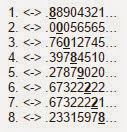
The argument is a reductio ad absurdum. Suppose the two sets were the same size. Then by the definition of same size, each real number somewhere in the range from 0 to 1 could be paired up with a positive integer and vice versa. Here is how such a pairing might look:


Consider the diagonal number that is produced by using a decimal point and then selecting the diagonal digits that are highlighted and underlined above:

.80089228…

This number might be somewhere down the list, but the following number definitely won’t be. Take each digit of the diagonal number and add one to it, but if the digit is 9 then replace it with 0.

That new number differs from the nth number in the list at least in its nth digit. It should be on the list but isn’t. That’s the contradiction. For any other table that tries to pair natural numbers with real numbers, there is a similar diagonal construction.


The Euthyphro dilemma (Plato’s Socrates)
Daniel Weijers

My interpretation:

What gives a moral truth its authority?

Are actions morally good because God commands them, or does God only command what is morally good?

Either:
1) the authority of a moral truth is established by God commanding it, or
2) God understands the authority and that leads him to make his commands
If 1 is true, then any moral truths established by God are arbitrary. (God could have commanded something different, and the authority of morality is not based on the reasons why God commanded what he did.)

If 2 is true, then God is not the source of morality. (God must be referring to some kind of moral reasons, principles, or rules in order to know what is morally good. Morality is not arbitrary on this view because it is based on reasons. God is not the source of morality on this view because the reasons, principles, or rules are the source or authority of morality and God is (presumably) using rationality to infer morality from those reasons, principles, or rules.)

This argument is important because, regardless of one’s religious beliefs, it encourages us to think carefully about what makes something morally good or bad. This kind of thinking is required for us to work out how to behave towards others in our diverse world. And it’s cool because I like to imagine God puzzling over trolley problems and experience machine scenarios (“it just is wrong to push the man!”)


Gewirth on agency rights
Kyle Swan

I think the best arguments begin with really simple and uncontroversial premises, which are used to develop much more substantive and interesting conclusions. Alan Gewirth (Reason and Morality, 1978) begins with the simple and uncontroversial thought that each of us considers the aims and purposes of our chosen actions as good (otherwise, why do them?). Each of us, then, should insist that others not interfere with these actions. We are all committed to objecting and resenting others when they prevent us from acting on what we consider good.

So, from the first-person point of view every agent is rationally committed to a) demanding that others not interfere with her actions and b) acknowledging that the basis of this demand is a generic feature of human agency. Therefore, c) every agent has the same basis for making this demand as she does, and d) anyone who made this demand for herself while refusing to acknowledge the standing of others to make it, as well, has contradicted herself.

This general commitment makes freedom of action a moral default. It's not absolute, of course, but it establishes a moral presumption and, for Gewirth, a very strong one so that no one's freedom may be restricted without special justification.


The no miracles argument
G. Randolph Mayes

The argument:
1. If successful scientific theories are not accurate descriptions of reality, then their success is a miracle.
2. The success of scientific theories ain't a miracle.
3. Therefore, successful scientific theories are accurate descriptions of reality.
The idea underlying premise 1 is that the best explanation of the success of science is that it provides accurate descriptions of reality. This is called an inference to the best explanation (IBE).

This argument is cool because it is both intuitively compelling and conceptually problematic.

I find it compelling in naturalistic terms: It seems right, e.g., that the relative success of organisms with minds seems (partially) best explained by the accuracy with which they represent their environment.

But the principle of IBE also strikes me as a confusion. Simply put: we can't infer that a theory is true or accurate because it is a good explanation. Being true is just part of what we mean when we say that an explanation is good.

There are other criteria, too, e.g., prediction, consilience, and simplicity. So we could just remove truth from this list. But then when we say that realism is the best explanation, what we mean is that it possesses these virtues to the greatest degree. Well, maybe so- compared to no explanation at all. But how good is it? What does it predict? What is unifying or simplifying about it? When you really hold it accountable to explanatory criteria, the no-miracles argument starts to feel like magic.


Queer, like… nothing else in the universe
Christina Bellon

In Ethics: Inventing Right and Wrong, Mackie offers an ‘Error Theory’ for how we have come to be so mistaken about what there is. One part is the Argument from Queerness:

1. If values are objective, then they must be metaphysically similar to other objective things. Objectivity entails that what is objective is real, i.e., is true against the way the world actually is (not against the way we agree it is, or against our practices, desires, perspectives, or semantics). For values to have this kind of objectivity entails “they would be entities or qualities or relations… utterly different from anything else in the universe” (38). 
2. If values are objective, then we must be able to know them. But, to know something “utterly different from anything else in the universe,” we’d need “some special faculty of moral perception or intuition, utterly different from our ordinary ways of knowing everything else” (38).

What makes this argument cool, is that Mackie demands that we question how we can know our moral judgments are true. Even obvious prescriptions, like ‘do no harm’, presume an entailment between the fact of pain and the wrongness of it. But this is not self-evident, as intuitionists and moral realists propose. Mackie’s Argument from Queerness jabs at that connection. This is not to say he’s right, but his jab demands we rethink what we take for granted when we declare anything to be wrong or right. It is also cool just ‘cuz of its name.


Singer’s argument for giving animals equal moral consideration
Scott Merlino

In Animal Liberation (1975) Peter Singer makes a compelling case for not using or consuming non-human animals when it is not necessary to our survival, because animals experience pain and suffering as we do, they need their lives as much as we do.

We really don’t accept that differences in intelligence between humans make it morally acceptable for some humans to eat or experiment or otherwise subordinate less intelligent humans, because intelligence is not the relevant difference we use to guide our treatment of others. The capacity for suffering is the only relevant difference. In suffering, animals are our equals.

Refusing to acknowledge animal vital interests on the grounds that they are not human or lack other qualities that humans have is a form of discrimination akin to racism and sexism, he calls it speciesism, which has the same recipe-for-exploitation rationale: Ignore or weigh differently the similar, vital interests of members of different groups.

Singer’s argument is cool because he extends the principle of equality that guides our treatment of fellow humans “consider and treat the interests of those who suffer equally” to non-humans. It isn’t fair for racists and sexists to discriminate on the grounds of real or perceived physical or cognitive abilities and then inflict suffering on those whom they subordinate, and it isn’t fair for speciesists. Sure animals eat each other, but unlike animals, we humans are morally responsible for what we do.


Fission and Fusion 
Russel DiSilvestro

Derek Parfit in Reasons and Persons asks us to imagine a fictional case where you are taking a timed exam with two problems left and only enough time remaining to finish one.

But, you can easily trigger a device in your brain—perhaps by raising your eyebrows—that effectively divides your stream of consciousness—and your ability to control your body—in two.

So the left half of you can work on one test problem at the same time as your right half is working on the other test problem.

The way Parfit describes it is great: for example, the left ‘you’ can see in its peripheral vision the right ‘you’ scribbling furiously as the clock ticks down, and can wonder what the right ‘you’ is thinking and feeling. And vice-versa.

This is an illustration of what it might be like to experience a certain kind of ‘division’ or ‘fission’ (in this case, binary fission, of one’s stream of consciousness and bodily control).

Of course, philosophers divide (pun intended) on what such a case might prove or illustrate about personal identity and other matters. (For example, do you literally become two persons? If not, which stream are you?)

But one reason I like the case is that Parfit quickly closes its description by imagining a ‘fusion’ once the test is over. (Perhaps the you—the left ‘you’?—blinks twice?) The individual at the end of the fusion (you?) suddenly remembers everything that happened in both streams.

It’s a great case.


Department of Philosophy
Sacramento State